
Kitchen trends 2026 – part 2
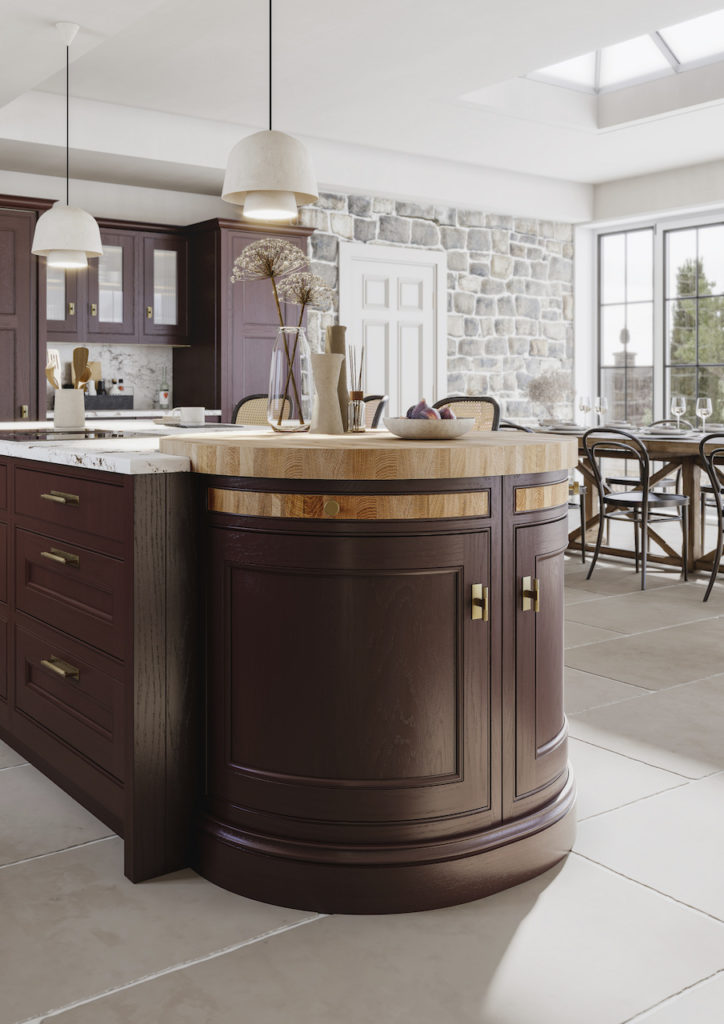
There’s something special about a beautifully designed traditional kitchen.
The proportions. The craftsmanship. The tactile materials. The sense that the furniture belongs in the room rather than simply filling it.
But traditional kitchen design is changing.
It’s becoming cleaner, bolder and more individual.
And one of the details we’re particularly excited about?
Curves.
Straight lines needn’t rule the kitchen
Kitchens naturally contain lots of straight lines – cabinets, drawers, worktops and islands.
Introduce a curve in exactly the right place and the whole room can feel different.
A sweeping end to an island softens a substantial piece of furniture. Curved cabinetry can make movement around a kitchen feel more natural. And where kitchens flow into dining and living areas, softer forms help blur the boundary between kitchen furniture and the rest of the home.
A good curve doesn’t demand attention. It simply makes the room feel better.
Traditional. Not predictable.
Traditional doesn’t have to mean country kitchen.
For us, it’s about taking the best elements of classic furniture making – proportion, framing, texture and craftsmanship – and using them in a fresh way.
The Clarendon range is a great example.
Its in-frame construction, Shaker influences, tactile ash grain and subtle detailing give it unmistakable character.
But then come the curves.
Concave and convex cabinetry allow us to shape the furniture itself, opening up much more interesting possibilities for islands, cabinet runs and transitions between spaces.
The result can feel unmistakably traditional and strikingly contemporary at the same time.
Why we’re bringing back the curve
Picture a large kitchen island.
Finish it with a square end and it does its job perfectly well.
Now let the cabinetry gently sweep around the end and allow the worktop to follow it.
Suddenly it feels less like a collection of kitchen units and more like a beautifully made piece of furniture.
That’s the difference.
Curves can soften corners, improve flow and introduce an architectural quality to a room.
But there’s a catch.
Don’t curve everything
Curves are appearing everywhere in interiors right now.
Furniture. Islands. Archways. Worktops. Shelving.
That doesn’t mean every corner needs rounding off.
Overuse them and a distinctive design feature quickly becomes a gimmick. Curved cabinetry can also add cost and sometimes sacrifice useful storage.
We’d rather introduce one beautifully considered curve in exactly the right place than add five simply because they’re fashionable.
Good design needs restraint.
Traditional has found a new confidence
We’re also seeing traditional cabinetry paired with much more adventurous materials.
Painted furniture with dramatic stone.
Warm oak against deep green.
Walnut with soft neutrals.
Classic cabinetry with contemporary lighting.
And we’re definitely moving beyond the idea that a traditional kitchen needs to be cream.
Rich greens, blues and earthy shades bring incredible depth to framed cabinetry, while visible timber grain and matt finishes add warmth and texture.
It feels luxurious without needing to shout about it.
Designed to belong
This is where traditional design really earns its place.
A great kitchen should respond to the architecture around it.
In a Yorkshire stone house, that might mean embracing original materials and proportions while introducing thoroughly modern functionality.
In a Victorian home, classic cabinetry can complement the architecture without trying to recreate the past.
And in a contemporary extension, traditional furniture can provide exactly the warmth and character that a large modern space needs.
There isn’t a formula.
And that’s precisely the point.
Are curves just another trend?
Probably.
But that’s not really what interests us.
The question isn’t whether something is fashionable in 2026.
It’s whether it makes the kitchen better.
Does that curved island improve the flow of the room?
Does that traditional cabinetry suit the architecture?
Does that beautiful timber bring warmth?
Does the layout work for the people who actually live there?
If the answer is yes, the design will last far longer than the trend.
Because ultimately, we’re not interested in creating a kitchen that looks good for 2026.
We’re interested in creating one you’ll still love long after it.
Beautifully Designed.
Perfectly Made.
For You.
Ewan Palmer
Palmer & Palmer | Bespoke Interiors